-
Definition of the search:
The search is the action to seek the game with method and intelligence.
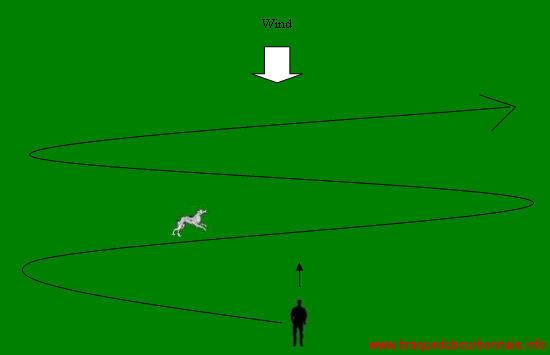
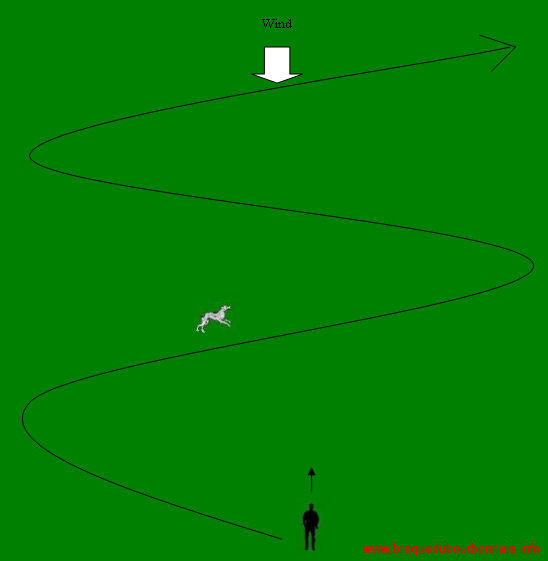
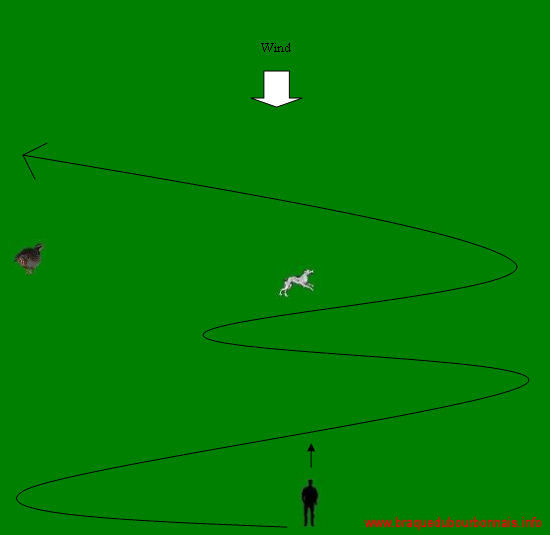
In the quartering style, the bends must be done leaning on the wind, the handler walking in front of the wind, as much as the field enables it.
The field must be fully explored, without loosing time to explore twice the same place.
-
Perfect quartering:
-
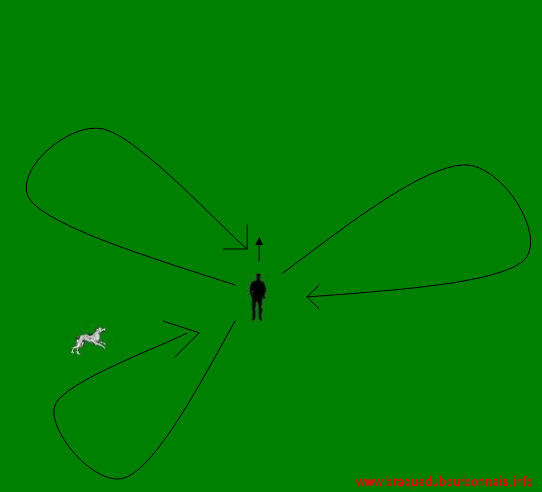
Daisy quartering:
The dog goes in every direction, his path then draws the
shape of a flower's petals. Is appropriate in a wood when the wind is null.
-
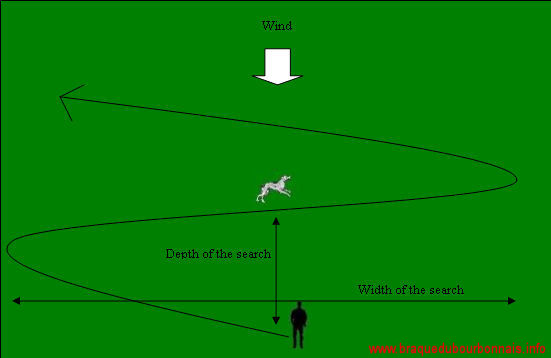
Quartering depth/quartering width:
The quartering depth is the distance at which the dogs passes in front of the handler,
the width is the distance from the place were the dog turns on the left to the place were the dog turns on the right.
Generally, the quartering depth is about 30 to 40 metres (useful range of a hunting gun), and the width about 80 to 100 metres.
-
Control on the ground:
Action of the dog who puts his nose on the ground to smell
a scent. Usually happens when the dog finds a track or a warm place. The dog must never end up tracking.
-
The minute:
During the first minute of the search, the rule says that all successful points will be counted,
but the faults won't eliminate the dog.
This minute is considered as a relaxation minute during which the dog is warming up and he can encounter a game below the wind without having the opportunity to smell it.
The same principle is applied when changing the terrain, (dog being leashed and sent again on another field):
bumping on a bird below the wind in the first bend doesn't count, because there also, the dog didn't have the opportunity to explore this terrain.
-
Faults in the search:
-
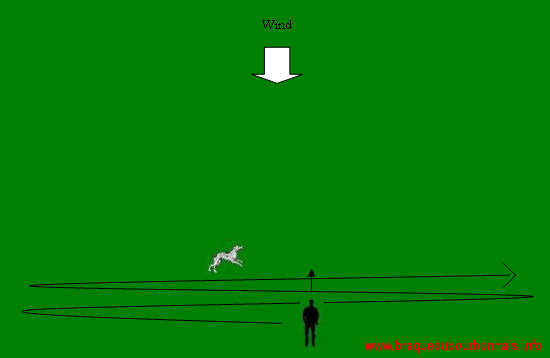
Running straight :
The dog waves straight into the wind, leaving the sides unexplored and moving away from his handler (one says that the dog is "taking a line").
Severe default which should be corrected as soon as possible by an appropriate teaching. Except if at the end of this line, the dog takes a point, in this case it is not a fault.
-
Tightened quartering:
The dog bends lack of depth, to the point that he passes behind his handler walking, generally it is the fact of a dog not giving the best of himself
or lacking confidence in his smelling capacities.
-
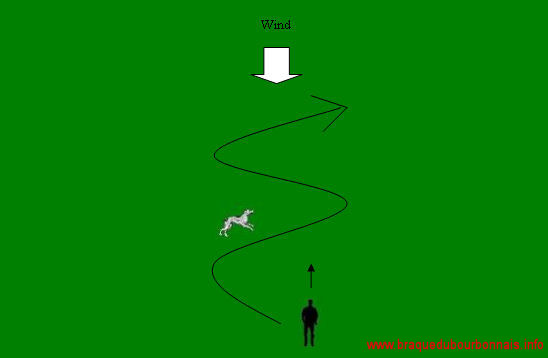
Restricted quartering:
Doesn't go far enough on both sides to be efficient.
-
Open quartering:
The bends leave too much field unexplored because the
quartering depth is too big (more than 40 to 50 meters).
-
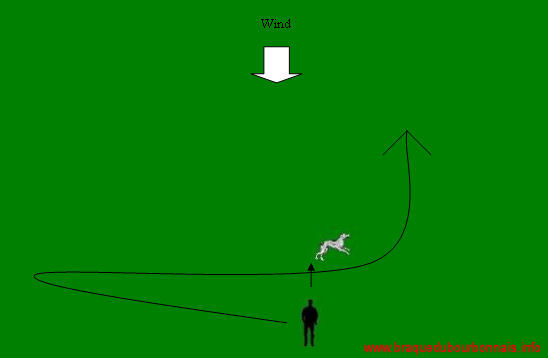
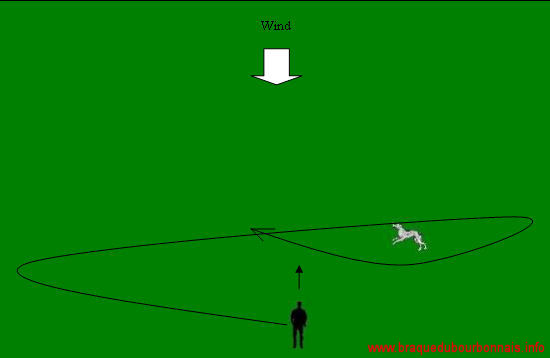
Backcast bend:
At the end of a line, the dog turns on the wrong side and comes back with the
wind at its back, which forces him to pass again on an already explored terrain.
-
Broad quartering:
The dog goes too far on the sides.
-
Badly tuned quartering:
The dog leaves a part of the terrain unexplored because his
bends are irregular.
-
To wax the boots:
Is said of a dog whose quartering lacks amplitude to
the point of not going far enough to be efficient.
-
To pursue:
In couple, the dog follows his brace mate instead to doing
his own search.